
Executive Offsite Playbook
Five Questions. Zero Slides. One Nervous System.

The following is a case study of an actual client leadership offsite. While this newsletter reveals an 18-person offsite, the frameworks shared could just as easily apply to a meeting of 4, or 150. While the name of the organization and industry is changed for anonymity, the specifics are exactly what we did, and what emerged.
I recently spent three days with the leadership team of Valor Pediatric Health — a mid-size network of pediatric care centers whose work touches thousands of families across dozens of communities.
Most leadership teams invest thousands of dollars per person and days of their most senior people’s time in executive offsites.
The results are not matching the investment.
A survey from MIT Sloan found that only 34% of executive teams report strong alignment on strategic priorities after their annual offsite.
McKinsey puts it even more starkly: fewer than 25% of executives feel their organizations are effectively aligned on strategy and priorities at all.
The corporate retreats market is heading toward $73.7 billion by 2034. Only 17% of companies have a formal system for measuring what any of it actually produced.
The problem is not that leadership teams are not meeting. It is that most of what happens when they do meet is not worth the time it costs.
Face-to-face communication is 34 times more effective than email at generating commitment and follow-through. Most executive offsites spend that irreplaceable time watching slides.
Let’s start with a simple premise, to frame how important this opportunity is:
Our world is changing faster than most organizations, and leadership teams feel equipped to deal with.
It’s harder to lead than ever before.
We need to evolve how our leaders lead, in order to meet increased levels of complexity and uncertainty.
Leadership meetings — whether small offsites or annual gatherings — are one of the greatest investments of resources, sources of leverage, and opportunities to affect an organization.
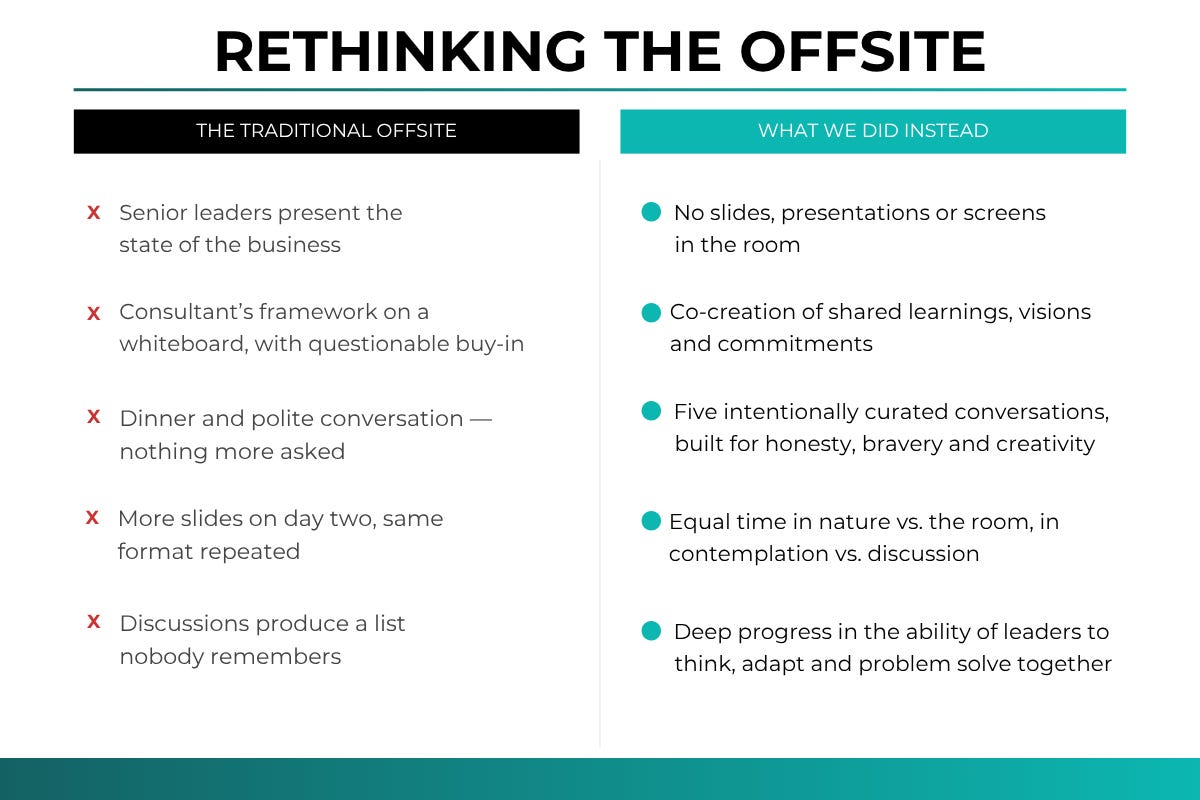
Most leadership offsites follow the same script. Fly everyone in. Open a deck. A senior leader presents the state of the business.
Then the next. Then the next.
There’s a strategy session, probably a consultant’s framework on a whiteboard.
Dinner with polite conversation.
Day two, more slides.
A breakout group that produces a list nobody fully remembers.
Everybody played it safe. Now we fly home.
The team spent two days together and barely scratched the surface when it comes to a genuine sense of safety, or honest exploration of conversations that felt like they mattered.
This might feel like a critique, but it’s well recognized. It’s a description of what most leaders have been taught an offsite is supposed to look like. Information gets delivered. Reports get filed. The team returns to work.
But there’s a different model. And it starts with a set of principles that many leadership teams have never been offered.
THE PARADIGM SHIFT
Before I walk you through what we did at the offsite, I want to name the shift in thinking that makes any of it possible. Because without this shift, the techniques are just techniques. With it, they become a fundamentally different way of leading a leadership team.
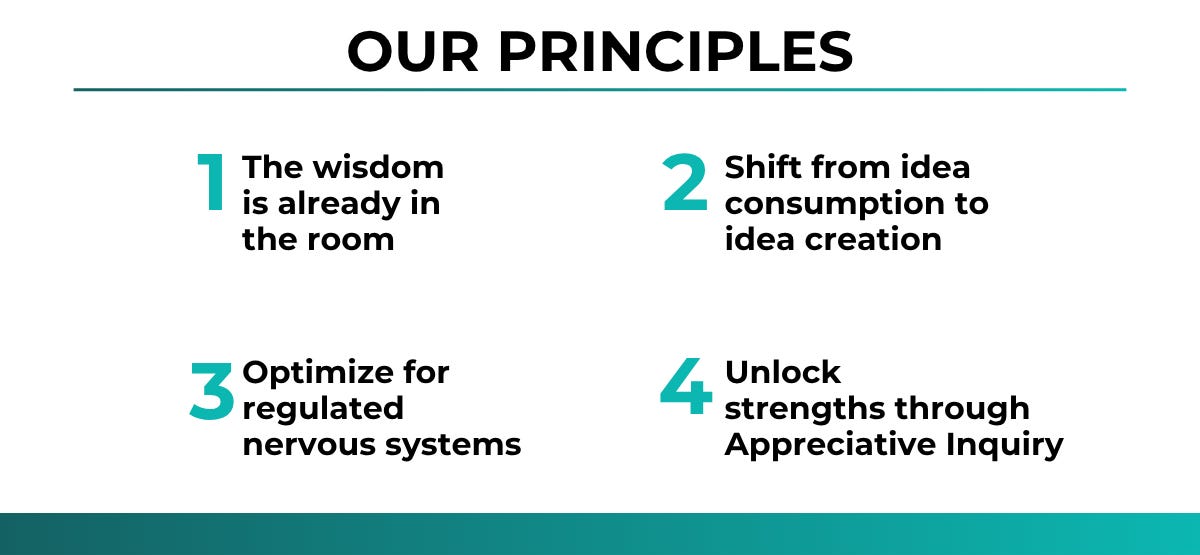
Principle 1: The wisdom is already in the room
The job of a well-designed offsite is not just to deliver insights to the team. It is to surface the collective wisdom the team already holds. To make it both visible and useful.
Principle 2: Shift from idea consumption to idea creation
Most leadership meetings are designed for information consumption. Leaders present & leaders consume. The paradigm shift is designing meetings where people also create — ideas, visions, solutions, commitments — together.
Principle 3: Optimize for regulated nervous systems
Honesty, creativity, and real collaboration require safety, not comfort. Safety is also what makes our higher creative and collaborative capacities come alive. It results from the structure of how we design and facilitate our time together — not through ground rules or declaration of an honest meeting.
Principle 4: Unlock strengths through Appreciative Inquiry
Each conversation is curated and designed with questions that allow the group to operate from individual and shared strength. This allows problems to be solved more efficiently, new possibilities to come alive more naturally, and increases creativity throughout the process.
This is not abstract.
DDI’s Global Leadership Forecast found that 71% of executives say their stress has surged since taking on their current leadership role.
Only 30% feel they have enough time to lead with the care and strategic thought the role demands.
Leaders do not need more pressure applied at their offsite. They need the conditions that allow them to think at their best.
These four principles are the foundation. Everything we designed at the offsite flows from them. Keep them in mind as you read what follows.
WHAT A TRADITIONAL OFFSITE CANNOT DO
Here is the core problem with slide-based, report-driven leadership meetings.
They are designed for one-directional information transfer. And information transfer is one of the least important things a leadership team needs from time together.
What they most need is to think together. To learn together. To see each other’s thinking in real time. To disagree well. To build something together they could not have built separately.
What we are ultimately aiming for is to tap into the collective intelligence of the group.
None of that happens when people are watching a presentation.
THE RESEARCH — COLLECTIVE INTELLIGENCE
In 2010, Anita Williams Woolley and colleagues at Carnegie Mellon and MIT published a landmark study in Science magazine. They measured collective intelligence across groups and found it is not predicted by the average IQ of its members, their credentials, or their experience. The primary predictor was the degree to which participation was equally distributed across all members of the group.
As Woolley’s research put it: the primary indicator that determines whether a group taps into its collective intelligence are the interaction patterns amongst its members. One voice presenting while eighteen minds are partially elsewhere is a design flaw hiding in plain sight.
The gap between investment and impact is measurable.
Companies with aligned leadership teams are 2.5 times more likely to outperform their peers on revenue growth.
The design of the experience determines whether collective intelligence gets accessed, or stays dormant.
THE CHOREOGRAPHY UNDERNEATH EVERYTHING
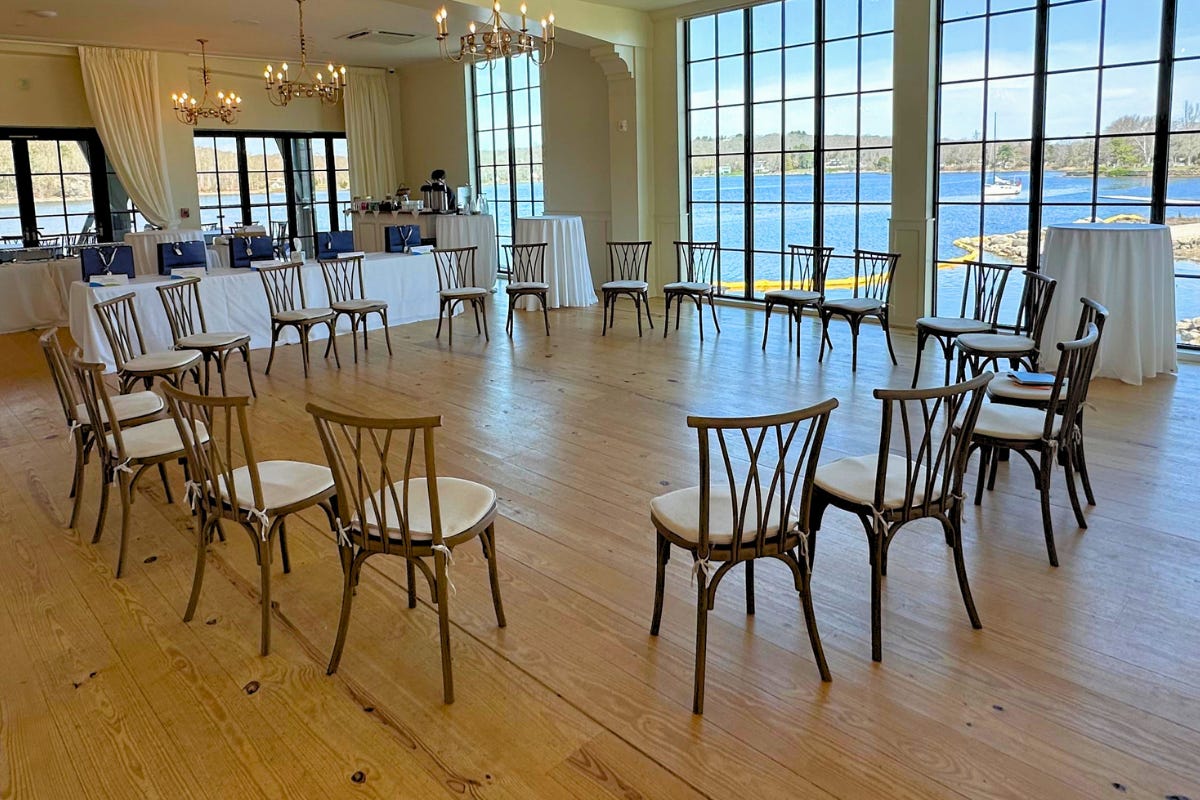
From the start of the meeting, eighteen leaders sat in a full circle — no tables between them, no podium, no projection screen.
For the majority of those three days, no slides, no presentations, no rehearsed reports.
The biggest role technology played: my small Bluetooth speaker for music, which plays a bigger role than you might think.
And we were constantly moving.
Pairs. Groups of three, four, or five. The full circle. And back again.
Every configuration was a designed decision.
We call these conversational choreographies. And the choreography is as important as the content.
Here is the framework we used for almost every conversation. We call it the three stages of an xchange.
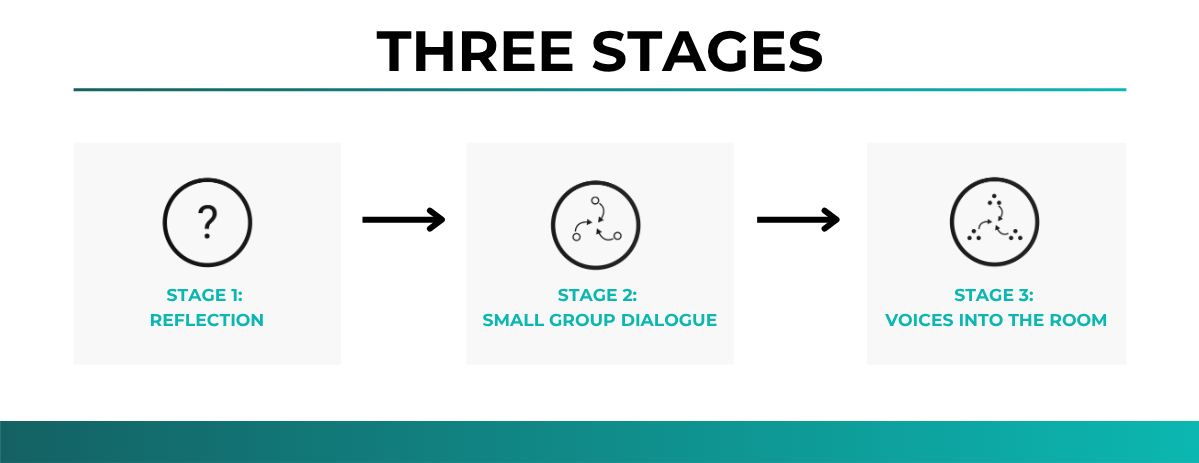
Stage 1: Reflection
Before anyone speaks, individuals sit with a question on their own. Reflection is what allows someone to locate what they actually think, before the room shapes what they say.
Stage 2: Small Group Dialogue
From reflection, people move into pairs, triads, or small groups. The size is a deliberate choice based on what the conversation is designed to produce.
Stage 3: Voices Into the Room
Small groups share back to the full team. The form changes: story sharing, theme harvesting, creative vision presenting, or declarations of commitment.
Why we almost always start in pairs
In a pair, two people share equal time. Everyone is fully in the conversation from the first moment. That is an example of an interaction pattern — a condition Woolley’s research identifies as the primary driver of collective intelligence.
But something else is happening at a neurobiological level.
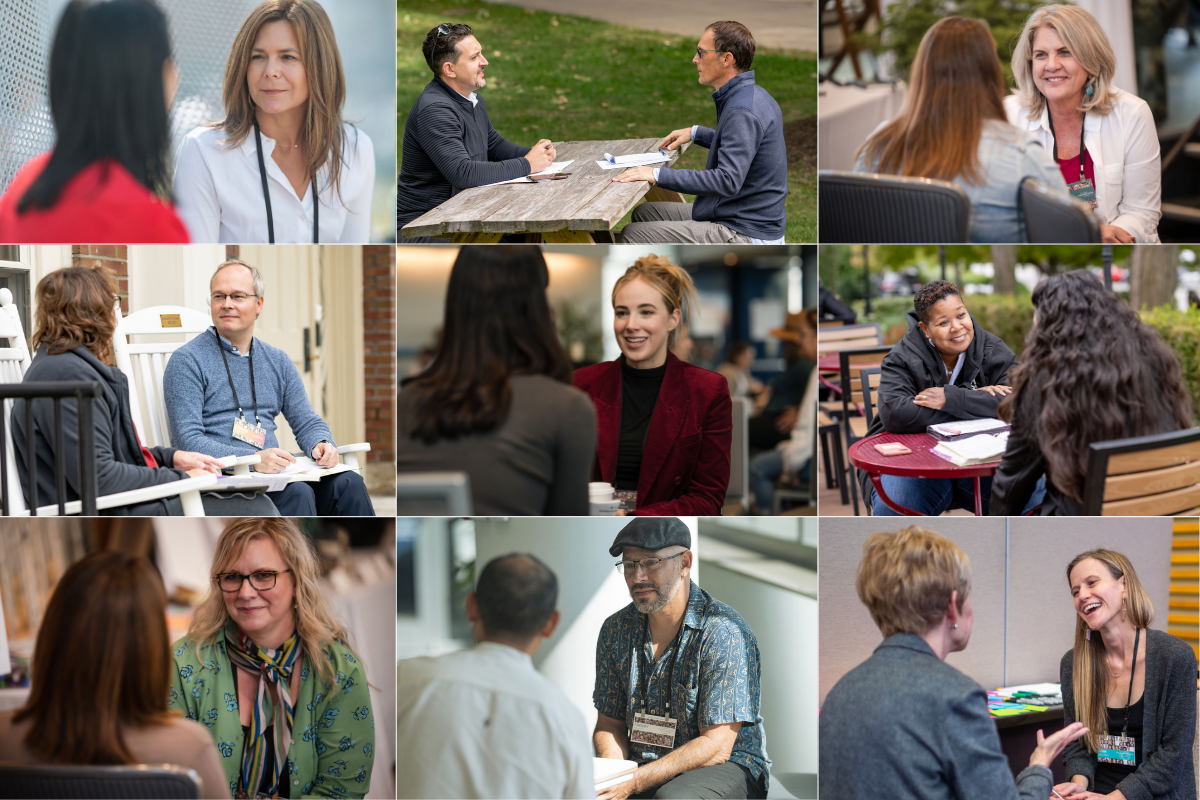
In pairs and other small group configurations, leaders are co-creating an experience that affects their individual and shared chemistry. There are multiple descriptions for what’s happening: co-regulation, social contagion, or the network effect. But beneath it all is something key. The experience of coherence.
THE RESEARCH — COHERENCE
The HeartMath Institute has nearly fifty years and over five hundred peer-reviewed studies behind their research on coherence — a physiological state where the brain, heart, and nervous system operate together at peak capacity. When two people are in genuine conversation, they begin to co-regulate each other’s nervous systems. Heart rate variability starts to synchronize between them. This is measurable. HeartMath calls it social coherence between two people, global coherence across a full group. The conversations are not just a social choreography — they are creating the neurobiological conditions for our highest ability to think, to relate, to create.
THE RESEARCH — PSYCHOLOGICAL SAFETY
Amy Edmondson, Novartis Professor of Leadership and Management at Harvard Business School, has spent decades studying psychological safety. Her research found that one of the strongest precursors to whether a group will take real risks is whether voices are equally invited into the conversation. Pairs do this structurally. No one can dominate. No one can disappear. Psychological safety is widely misunderstood as a condition where everyone is nice to each other. In practice, it is almost the opposite. When real safety exists, a team can navigate the more difficult conversations with greater skill — disagreeing, challenging, naming what others are afraid to say.
We build safety through structure, before we ever expect the group to be honest, brave, or creative.
THE FIVE CONVERSATIONS
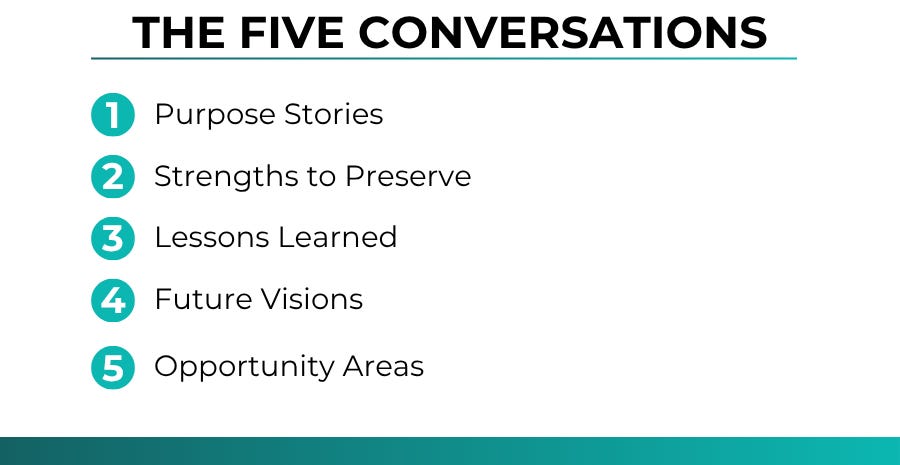
Conversation 1: Purpose Stories
The first thing I asked the Valor leadership team to do was reflect, individually, on a single question:
Think about all of your lived experiences here.
Now reflect on a story — a real example —
that stands out more than any other, that reminds
you why the work you do is so important.
Then they moved to high-top tables around the room. Groups of three or four, self-organized.
Each person shared their story.
What came back into the room was more than just a conversation exercise. It was felt by many as a sort of ceremonial opening to our time together.
WHAT CAME BACK INTO THE ROOM
A leader described a clinic coordinator — sixteen years with the organization — who knew every patient and family by name, who moved through her day as though her job description was simply to care for whoever was in front of her
Another described clinical staff driving across town on their day off to attend the memorial service of a longtime team member — showing up together because that is who they are
A leader who had come from a metrics-driven corporate background described his second week: a child had been discharged after a long stay, and the entire floor stopped to cheer. He went home and told his wife: “I’ve never worked anywhere like this.” And something shifted in him permanently.
Most leadership teams never create this conversation. They treat purpose as a noun. A statement. Something static that lives on a wall.
Purpose stops being above or outside the team. It activates through them, through the choice to bring these stories into the room.
THE RESEARCH — MIRROR FLOURISHING
Dr. Ron Fry and David Cooperrider spent over thirty years studying organizational change before articulating what they called mirror flourishing. The observation: one of the most powerful ways to bring people alive as individuals is to draw their attention to the profound impact they are already making in the world. The mirror neuron cannot help but want to see itself as part of that story.
Conversation 2: Strengths to Preserve
Considering Valor had just navigated several years of extraordinary change — which would likely continue — there was a felt sense in the room that they needed space to honor what had gotten them to where they are.
No matter how they were going to change or evolve, there was a need to crystallize the qualities that should be nurtured, protected, and preserved. A conversation about strengths was central to this.
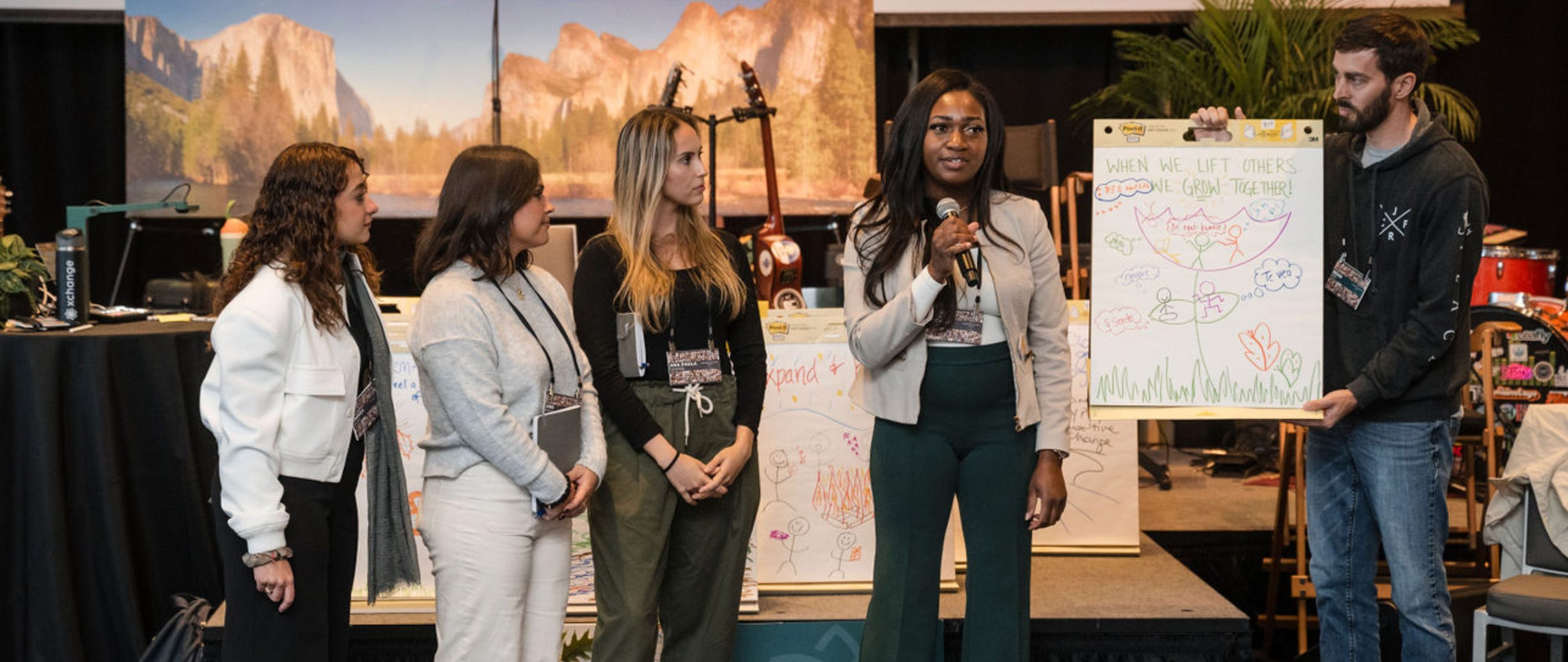
After time in working groups, they had a chance to capture and present to each other the strengths they most wanted to honor.
Three themes came back consistently:
WHAT THE TEAM NAMED AS THEIR STRENGTHS
Human connection — a depth of care and presence that ran from the clinical floor to the executive team
Active, structured leadership — thoughtful decision-making and real accountability at every tier of the organization
Growth mindset — “People here truly want to get better at what they do. That drive is a core part of who we are.”
Peter Drucker said the task of leadership is to align strengths so thoroughly that weaknesses become irrelevant.
This conversation does several things at once. It honors history.
It grounds everything in what is real rather than theoretical.
It creates collective pride.
And it answers one of the quietest anxieties in any leadership transition: will what made us who we are actually survive what comes next?
Conversation 3: Lessons Learned
If strengths look backward with gratitude, lessons look backward with honesty.
The question: what has this last chapter taught us?
What should we carry forward?
THE RESEARCH — LEARNING ORGANIZATIONS
In the early 1990s, Peter Senge defined the learning organization simply: an organization that has the capacity to learn together so it can continually navigate change. In systems thinking, learning is a survival skill. A living system that cannot learn cannot adapt. A living system that cannot adapt will not survive. The idea has never been more relevant than it is now.
The Valor team named hard-earned, specific lessons.
About tolerating the wrong behaviors for too long.
About what it means to hold high standards when the pressure is simply to get through the season.
About how quickly institutional knowledge can be lost when the conditions for passing it on are not deliberately created.
Part of what makes these kinds of collective dialogues so important is the validity and buy-in that is inherent in the discussion. All the learning came from their own lived reality. This invites trust in whatever emerges.
The data no one ever disagrees with is their own.
Conversation 4: Future Visions
On the second day, I gave the team a single prompt. I asked them to take it outside, alone, with blank paper and fifteen minutes.
Imagine it is five years from now. The story of this organization
has become an inspiring and shining example of a network
that does well while also doing so much good.
What does that look like? What do you see, hear, feel?
When they returned, they moved into small groups. Not to compare notes, but to co-create. Each group took the raw material of their individual reflections and built something together — a shared picture of a future that none of them had arrived at alone.
Margaret Wheatley, one of the most respected voices in organizational thinking, observed that people support what they help create. Co-creation is not a nice-to-have. It is the mechanism by which ownership transfers from the facilitator to the group.
When the groups presented, they did not share a strategy deck, or a list of measureables.
They shared a story.
WHAT THE GROUPS CREATED
One group presented a magazine cover — their organization featured in a national healthcare publication. The headline: “How Valor became the beacon of pediatric care.” A lighthouse, they said, among difficult waters.
Another group acted out a scene: an orientation day five years from now, playing both the new clinicians lining up to join and the families choosing their care provider. The room laughed and filled with pride in the same breath.
What they created was genuinely theirs. No consultant handed it to them. No slide deck prompted it. It came from inside the room.
We are not creating the future to put it on a wall. We are building the practice of creating together.
THE RESEARCH — STRATEGIC RENEWAL
Gary Hamel, one of the most cited contributors in Harvard Business Review history, argued that one of the most important capacities for modern leadership is the ability to accelerate the rate of strategic renewal. His point: the organizations which will thrive are not those with the best five-year plans. They are the ones that have learned to come back together, as often as needed, and reimagine the future once again. Not competitive advantage at a moment in time. Evolutionary advantage over time.
Conversation 5: Opportunity Areas
The transition from future visions to opportunity areas is one of the most important moments in a strategic conversation like this one.
After the groups had presented their future visions, every person in the room received a single question on a piece of paper:
After sitting with our shared visions of the future,
what do you believe are the single most important
opportunity areas we need to focus on in
order to make that future come true?
Each person answered independently, in writing, and handed their responses in.
We synthesized the responses overnight. What made this moment so striking was the degree of alignment. Eighteen people, working independently, named the same three things.
THE THREE OPPORTUNITY AREAS THAT EMERGED
Technology, data, and service — mentioned by 12 of 18 leaders, and surfaced independently in two of the three future vision presentations. The team saw technology not as a threat to their human-centered culture, but as the lever that could extend and scale it.
Talent — raising the bar and growing people — named by at least 10 leaders and acknowledged in all three future presentations. The shared conviction: the future they wanted to create would only be possible if they continued to invest in who their people were becoming.
Discipline, execution, clarity, focus, and accountability — surfaced by at least 9 leaders. The honest recognition that vision without execution is just a story. The team knew that realizing their futures would require a sharper operating discipline than the one they currently had.
The following morning, we presented the three opportunity areas back to the group. Rather than reading them myself, I asked the leaders who wanted to read each one aloud. The head of technology took the first. HR took the second. Someone else took the third.
In that moment, the opportunity areas stopped being outputs from a process and became something the group owned.
What followed was a two-part ideation process. First, each leader took time alone, in silence, to capture their best ideas in response to a simple prompt for each area:
how might we?
One idea per post-it. Bold and practical. No filtering.
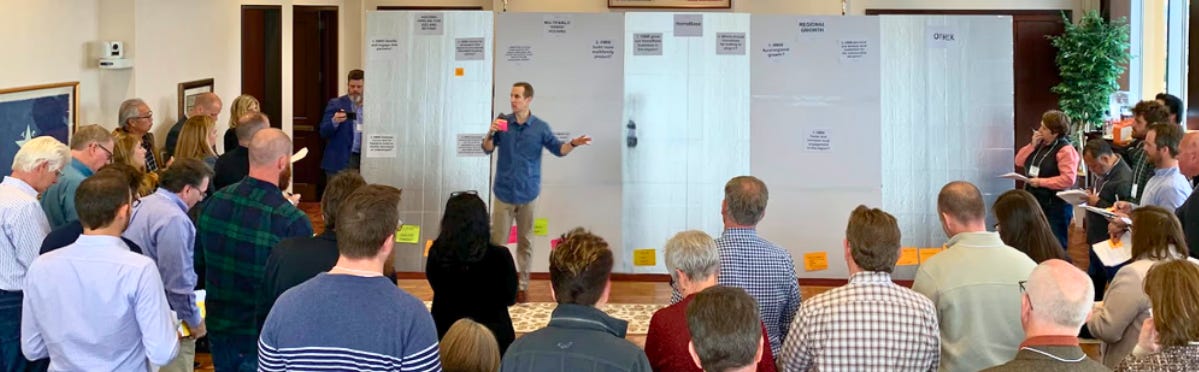
Then we ran what we call one conversation. The three opportunity areas were posted on flip charts around the room. One at a time, leaders came forward, placed their post-it on the board, and told the group what was on it. No discussions. No debates. Just witnessing. The only rule: when you come up, you share what’s on the note. It can’t be a TED talk.
What emerged across the three flip charts was a map of the group’s collective thinking — dozens of ideas, visible to everyone, organized by theme. The room could see its own intelligence reflected back at it.
From there, leaders self-organized into working groups by whichever opportunity area they were most energized to contribute to. Each group had one task: of everything on the table, what are the two or three ideas most worth pursuing, and what would it take to make one of them real?
The groups worked. Then they presented.
Future first. Opportunities second. Ideas from the collective. Then the real work of choosing what to pursue together.
WHAT THREE DAYS PRODUCED
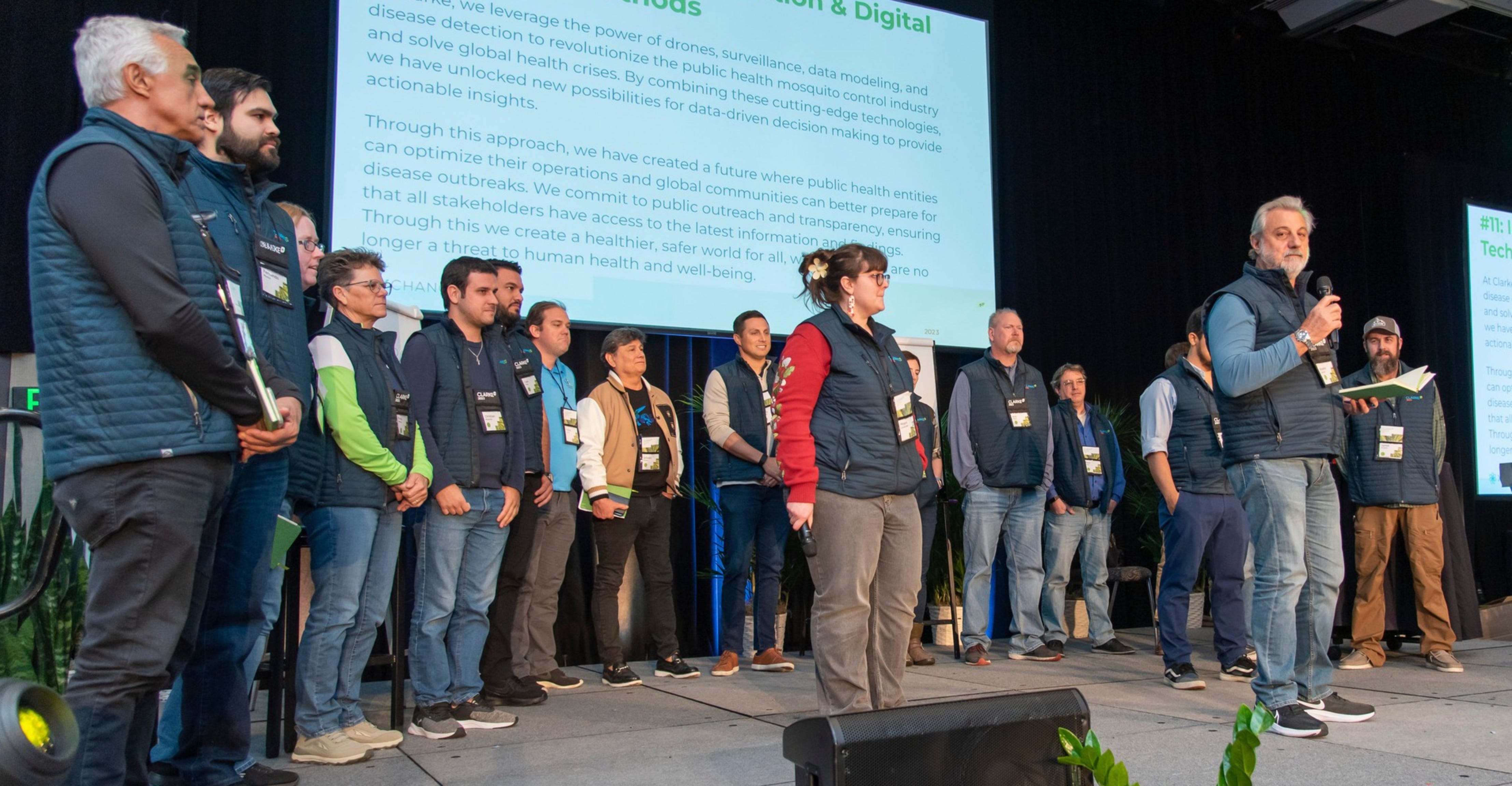
The Valor leadership team left with a shared story about who they are. A set of strengths they named and chose to protect. Lessons they surfaced and chose to carry. Future visions they built together — including a magazine cover nobody in that room will forget. Three opportunity areas they named themselves, with nearly unanimous alignment. And a set of ideas and commitments that came from the room, not from a consultant.
Those outputs were real. And they were not the most important thing.
The most important thing was what the team became in the process of creating them.
A team that has now learned how to think together. A team that has experienced, in their own nervous systems, what it feels like to be genuinely heard by the person across from them. A network caring for thousands of families across dozens of communities — now with a stronger evolutionary advantage than they walked in with.
Glassdoor’s 2026 Worklife Trends report found that mentions of “misalignment” in employee reviews surged 149% year-over-year.
The organizations that close that gap will not do it with better dashboards. They will do it by redesigning how their leaders actually spend time together.
Whatever their future holds, and none of us can predict it, they now have something more durable than a plan.
They have a practice.
And that is what conscious convening makes possible.
P.S. If you design or lead experiences for leadership teams and want to go deeper on conversational choreography, the five conversations, and the science underneath the structure, this is the work we teach at xchange. You are invited to explore what that looks like at xchangeapproach.com.
Love this!
This is such an exceptional asset to showcase your methodology and show how you apply it. Yes, the results are great but what a sales enablement tool!!